How to Stay Top-of-Mind Without Constant Content Creation

There is a pervasive myth in the digital marketing world that says if you aren’t visible, you don’t exist.
We’ve all heard the advice: “Post every day. Go live three times a week. Use every new feature the algorithm releases. If you aren’t in their faces, they’ll forget you.”
For the introverted entrepreneur, this advice isn't just exhausting it’s a fast track to burnout. It creates a "visibility trap" where you spend more time feeding the social media machine than you do serving your clients or doing the work you actually love. You start to feel like a content creator first and a business owner second.
But here is the truth that the "hustle" gurus won't tell you: Visibility is not about volume. It’s about value and strategy.
Staying top-of-mind doesn’t require a 24/7 presence. It requires a strategic presence. This is what I call Minimum Viable Visibility (MVV). It is the philosophy of doing the 20% of marketing activities that yield 80% of the results, allowing you to maintain your authority and attract high-quality leads while protecting your most valuable resource: your energy.
In this guide, we are going to dismantle the "post daily" mandate and replace it with a sustainable, strategic framework designed specifically for the way introverts work best. You’re going to learn how to stay visible with a fraction of the effort, without sacrificing an ounce of impact.
Section 1: Redefining Visibility for Introverts
To build a sustainable business, we have to first change how we define "visibility."
In many circles, visibility is treated as a synonym for "noise." We’ve been conditioned to believe that more is always better. More posts, more reels, more emails, more notifications. But for an introvert, "more" often leads to a decrease in quality and an increase in resentment toward our own marketing.
Visibility ≠ Volume
True visibility isn't about how many times people see your name in their feed. It’s about the quality of the impression you leave when they do see you. You can post every single day and still be invisible if your content is shallow, repetitive, or clearly forced.
Conversely, you can post once a month and be deeply visible if that one piece of content solves a massive problem, shifts a perspective, or starts a meaningful conversation. Strategic visibility is about being impactful, not just present.
The "Memorable Over Frequent" Principle
Think about the people you follow who you truly respect. Do you respect them because they post five times a day? Or do you respect them because when they do speak, they have something profound to say?
As introverts, our greatest marketing strength is often our ability to go deep. We are naturally inclined toward observation, reflection, and nuance. When we try to play the "high-frequency" game, we trade our depth for speed. We stop being memorable and start being part of the background noise.
The goal of Minimum Viable Visibility is to be so memorable that you don't need to be frequent. When you provide high-level insights, people will seek you out. They will bookmark your articles, share your videos, and remember your name when they need the specific solution you provide.
Section 2: The Minimum Viable Visibility Framework
Sustainable marketing requires a structure. Without a framework, you’ll find yourself waking up on a Tuesday morning wondering what to post, which is exactly how the cycle of "content panic" begins.
The MVV framework is built on three essential pillars.
Pillar 1: The Cornerstone Content Strategy
The foundation of your visibility should not be a fleeting social media post. It should be what I call Cornerstone Content.
Cornerstone Content is ONE exceptional, high-value piece of content that you create once a month (or even once a quarter). This is the content that establishes your "Quiet Authority." It is deep, comprehensive, and lives on a platform you own (like your website) or a high-authority platform like LinkedIn or YouTube.
What makes content "cornerstone-worthy"?
It solves a core problem: It doesn't just scratch the surface; it provides a roadmap.
It showcases your unique methodology: It explains how you do what you do.
It is evergreen: It will be as relevant six months from now as it is today.
It is meaty: Think 2,000+ word guides, original research, or deeply detailed case studies.
The Distribution Strategy: Once you have your cornerstone piece, you don't just "hit publish" and move on. You spend the rest of the month getting maximum mileage out of it. One cornerstone article can be broken down into:
4-5 LinkedIn posts
A series of Instagram Stories
An email newsletter
A guest speaking topic
Short-form video scripts
By focusing on one "Big Win" per month, you remove the pressure of constant creation while ensuring that your most important ideas are actually reaching your audience.
Pillar 2: The Strategic Touchpoint System
You don't need to be everywhere. You just need to be where your ideal clients actually are.
Most entrepreneurs are spread too thin across five or six platforms. The MVV approach asks you to identify the 3-5 strategic touchpoints where your presence will have the most impact. For most service-based businesses, this usually looks like:
One primary social platform (e.g., LinkedIn or Instagram).
Your email list (where you deepen relationships).
A "search-based" platform (e.g., Google/Blog or YouTube).
The "Weekly Presence" Minimum: Instead of daily posting, aim for a "weekly presence" minimum. This might mean:
Showing up on LinkedIn twice a week with high-value commentary.
Sending one thoughtful email to your list.
Engaging in the comments of industry leaders for 15 minutes, three times a week.
This isn't about being a ghost; it's about being a guest who arrives with something valuable to contribute, rather than someone who just stands in the corner shouting.
Pillar 3: The Visibility Calendar (Seasonal Planning)
Business has seasons. Your marketing should reflect that.
Most content creators treat every week like it's a "launch week," maintaining a high-octane presence 52 weeks a year. This is the fastest way to hit a wall. Instead, plan your visibility in seasons:
High-Visibility Months: These align with launches, new offerings, or peak industry seasons. You might increase your touchpoints to 3-4 times a week.
Maintenance Months: These are for the "in-between" times. You stick to your cornerstone content and your weekly minimums.
Rest/Deep Work Months: These are times when you intentionally pull back. You might only send your newsletter and rely on your evergreen content to do the work.
Using an Annual Visibility Template allows you to see the "peaks and valleys" of your energy expenditure. You can see exactly when you’ll need to be "on" and, more importantly, when you have permission to be "off."
Section 3: Platform-Specific Minimum Viable Strategies

Not all platforms are created equal. Depending on where your audience hangs out, your "minimum viable" effort will look different. Here is how to handle the major players without losing your mind.
LinkedIn: The Thought Leadership Platform
LinkedIn is the gold mine for introverts. Why? Because the platform favors long-form text, thoughtful insights, and professional networking over "aesthetic" visuals or trending dances.
The Schedule: 2-3 posts per week. That’s it.
The Strategy: Focus on Commentary. Instead of always trying to come up with original "hacks," react to industry news. Share a link to a relevant article and add your 200-word perspective. This positions you as an expert who is "in the know" without requiring you to build everything from scratch.
Strategic Engagement: Spend 15 minutes a day (or 3 days a week) commenting on the posts of 5-10 "dream clients" or peers. This builds visibility in the most direct way possible—by actually talking to people.
Instagram: The Community Platform
Instagram can be a trap for introverts because of its heavy focus on "being seen." To make it sustainable, shift your focus from broadcasting to connection.
The Schedule: 3 posts per week (Grid).
The Strategy: Use Stories for connection, not "content." You don’t need a produced script. Share a behind-the-scenes thought, a book you're reading, or a quick win a client had. Stories disappear in 24 hours, which lowers the "performance" pressure.
DMs are the Goal: Your posts shouldn't just be for likes; they should be to start conversations. Use polls or questions to invite people into your DMs, where introverts often shine in 1-on-1 settings.
Your Website/Blog: The Authority Hub
Your website is the only piece of digital real estate you actually own. It should be the home of your Cornerstone Content.
The Schedule: 1-2 in-depth posts per month.
The Strategy: The "Evergreen Library" approach. Instead of blogging about "What I did this weekend," write about "The 5 Reasons Your Strategy is Failing." Over time, these posts become an asset library.
The Power of Updating: One of the best MVV secrets is that you don't always need new content. Every six months, go back to your top-performing blog posts, update the statistics, add a new example, and re-share them. It counts as "new" to most of your audience and saves you 80% of the creation time.
Podcasts/Guest Appearances: Borrowed Visibility
This is the "Introvert’s Cheat Code." Instead of building an audience from scratch, you "borrow" someone else's.
The Schedule: 1-2 strategic guest appearances per quarter.
The Strategy: Choose podcasts that align perfectly with your niche. One 45-minute interview can stay "visible" for years as new people discover that podcast episode.
Repurposing: Record the interview (if allowed) or take notes on the questions you were asked. Those questions are exactly what your audience wants to know—turn them into your next month’s social media posts.
Section 4: Visibility Multipliers
How do you make one hour of work feel like ten? You use Multipliers. These are the tactical ways to amplify your presence without adding more hours to your workweek.
Multiplier #1: Repurposing (The 1-to-10 Rule)
Never create something that only gets used once. If you write a long-form article, it should be sliced and diced into a newsletter, several social posts, a video script, and a downloadable PDF. This ensures your best ideas are seen by the people who prefer different formats.
Multiplier #2: Collaboration
Co-creating content with a peer is visibility magic. When you do a joint webinar or a "collab" post, you are instantly introduced to their entire audience (and vice versa). It’s a 50% reduction in workload for a 200% increase in reach.
Multiplier #3: Curation
You don't always have to be the source of the wisdom. You can be the curator. Sharing a "Friday Favorites" list of the best articles, tools, or books you've found this week provides immense value to your audience with very little "creation" required from you.
Multiplier #4: Community Engagement
Let your audience amplify you. Encourage them to share your content or ask questions. When you answer a question in a public forum or a Facebook group, you aren't just helping one person, you are demonstrating your expertise to everyone else lurking in that group.
Multiplier #5: SEO (The Long Game)
SEO is the ultimate multiplier. By optimizing your Cornerstone Content for search engines, you are ensuring that your visibility compounds over time. A post you wrote two years ago can still be bringing you leads today while you are taking a nap or on vacation. That is the definition of sustainable.
Section 5: When to Increase Visibility (And When to Decrease)

Image by Juicy fish on Freepik.com
One of the biggest mistakes entrepreneurs make is trying to maintain a "steady state" of high visibility. This is not how humans or businesses work.
Launch Seasons: Ramping Up
When you have something to sell, you should be more visible. This is when you use your "Visibility Reserve." Because you’ve been practicing MVV during your maintenance months, you have the energetic bandwidth to show up more frequently during a two-week launch. You might go from 2 posts a week to 5. You might hop on more guest spots. This increase is temporary and purposeful.
Rest Seasons: Maintaining the Minimum
After a launch or a heavy project, you must give yourself permission to retreat. This is where your MVV system keeps the lights on. You fall back to your "Minimum Viable" routine, the automated emails, the pre-scheduled cornerstone posts, and the evergreen SEO. Your business stays top-of-mind while you recharge.
The Visibility/Energy Audit
Every 90 days, ask yourself:
Which platform felt like a chore?
Which piece of content actually led to a discovery call?
Where am I performing "visibility" just for the sake of it?
If a platform is draining your energy and not providing ROI, give yourself permission to drop it or automate it.
Section 6: Measuring Visibility ROI
If you can't measure it, you'll always feel like you aren't doing enough. To stay committed to a "Minimum Viable" approach, you need to see that it’s actually working.
Vanity Metrics vs. Revenue Metrics
Stop obsessing over likes, follows, and "reach." These are vanity metrics that often have zero correlation with bank deposits.
Instead, track Revenue Metrics:
Inbound Inquiries: How many people reached out specifically mentioning a piece of content you created?
Email Click-Through Rates: Are people engaging with your deep-dive content?
Conversion Rate: How many of your "low-frequency" leads actually turn into high-ticket clients?
The 90-Day Visibility Experiment
Commit to the MVV framework for 90 days. Stop the daily grind and focus solely on your Cornerstone Content and your Strategic Touchpoints. At the end of the three months, look at your revenue and your lead quality. Most introverted entrepreneurs find that while their "likes" might go down slightly, their lead quality and revenue stay the same or go up, and their stress levels plummet.
Conclusion: Visibility is a Tool, Not a Goal
At the end of the day, visibility is simply a tool to help you reach the people you are meant to serve. It is not an end in itself. You do not win a prize for having the most posts on Instagram; you win by building a business that supports your life and provides value to your clients.
You have permission to do less. You have permission to be quiet. You have permission to stop competing with the "loudest" people in the room and start competing with your own best ideas.
Your next step: Design your Minimum Viable Visibility plan. Pick your one cornerstone piece for next month, identify your three key touchpoints, and clear the rest off your plate.
The world doesn't need more noise. It needs your specific, strategic, and quiet authority.
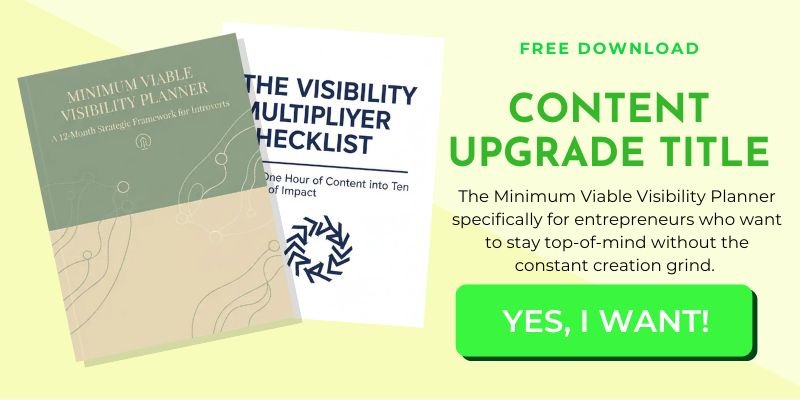
Stop the Content Chaos: Get the Minimum Viable Visibility Planner If you’re ready to trade "posting for the sake of posting" for a strategy that actually builds authority, I’ve put everything we’ve talked about today into a single, usable system.
The Minimum Viable Visibility (MVV) Planner includes:
The Annual Visibility Map: To help you plan your rest seasons before your launch seasons.
Platform-Specific Playbooks: The "minimum requirements" for LinkedIn, Instagram, and your website.
The 1-to-10 Multiplier Checklist: My exact process for turning one cornerstone article into weeks of content.
The Low-Energy Swipe File: Templates for the days when you have zero "creation energy" but need to stay visible.